Quick Answer: The Sleepypod Clickit Utility is the best dog car harness for most owners — it’s one of the few harnesses to earn independent CPS crash-test certification, and its direct seatbelt-buckle design eliminates the tether as a potential failure point. If you travel in an SUV or wagon and can invest more upfront, the Gunner Kennels G1 crate is the single safest option on the market, period.
If you’ve ever searched for the best harness and buckle situation to keep your dog safe in the car, the honest answer might surprise you: most harnesses sold in pet stores have never been independently crash tested. Not once. That’s not a marketing claim — it’s the finding of the Center for Pet Safety (CPS), which published a landmark study showing 11 of 12 popular harnesses failed catastrophically at just 30 mph. Before you grab whatever’s on sale, it’s worth understanding what actually separates a genuine safety device from a leash with good branding.
The Best Dog Car Harness and Buckle Setup: Quick Picks
Best Overall Harness: Sleepypod Clickit Utility
The Clickit Utility is one of the only harnesses to achieve CPS certification. It clips directly into the vehicle’s seatbelt receiver — no tether — which means one less failure point in a crash. For most dog owners driving a sedan, hatchback, or SUV, this is the harness to buy.
Best Overall Safety (Any Format): Gunner Kennels G1
For dogs riding in the cargo area of an SUV, wagon, or truck, a properly secured crash-tested crate outperforms every harness in severe collisions. The Gunner G1 earned a 5-Star CPS rating — the highest of any product reviewed here. It’s expensive, but nothing else comes close to its safety margin.
Why this matters: A 60 lb dog traveling at 35 mph generates approximately 2,700 lbs of force in a sudden stop. That’s not a dog anymore — that’s a projectile. And yet roughly 84% of dog owners drive with an unrestrained dog at least occasionally.
What to Look For in a Dog Car Harness or Restraint
CPS Certification: The Only Independent Crash-Test Standard That Matters
The Center for Pet Safety is a non-profit founded in 2011 that conducts independent crash testing using a protocol adapted from FMVSS 213 — the same federal standard applied to child safety seats. Tests run at 30 mph with a 20g deceleration pulse using weighted dog surrogates. Manufacturers don’t pay for the result; they submit a product and it either passes or fails.
Fewer than 10 harnesses have ever passed. Most products on the market have never been submitted. When a brand says it’s been “crash tested,” ask who did the testing. If it was the manufacturer’s own lab, that’s not independent certification.
Harness vs. Crate vs. Booster Seat
A crash-tested crate secured to the cargo area is the safest option in a severe crash. It contains the dog on all sides and distributes force through the crate structure rather than the dog’s body. A crash-tested harness is the most practical choice for vehicles without a proper cargo area. Booster seats serve comfort and minor containment for small dogs but should never be treated as a primary crash-safety device.
Collar-only attachment is genuinely dangerous at any speed. All crash force concentrates on the cervical spine and trachea — the same reason no one builds a child seat with a neck strap.
Attachment Point and Buckle Design
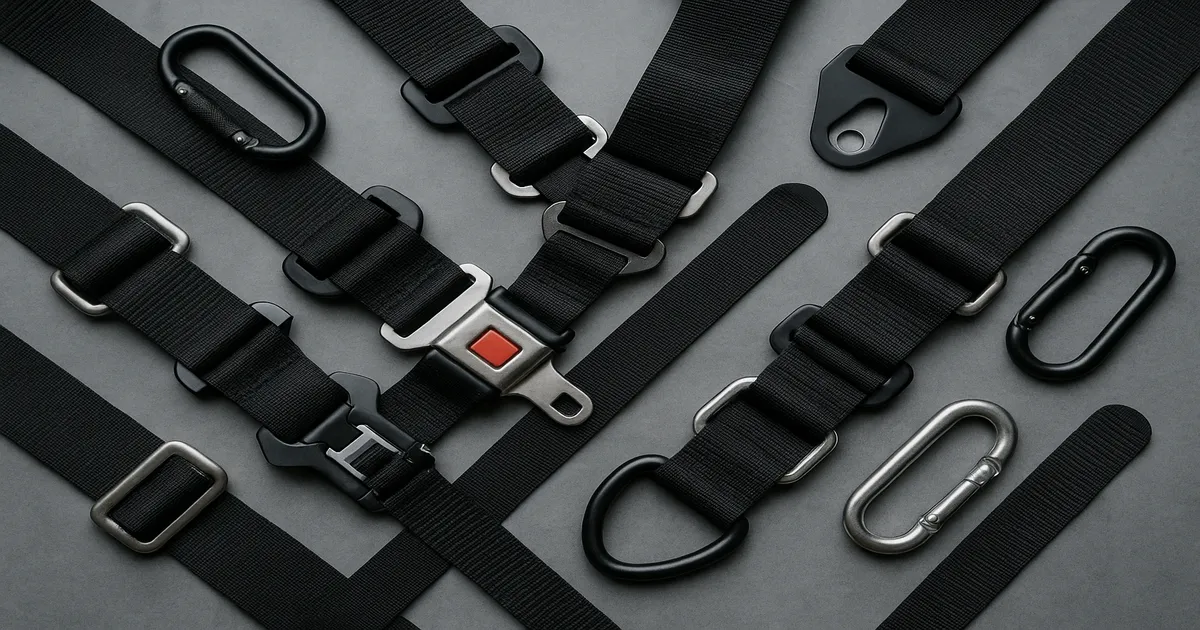
There are two main designs in the harness market. Direct buckle-in harnesses (like the Sleepypod Clickit) clip straight into the vehicle’s seatbelt receiver, using the belt’s own geometry to restrain the dog. Tether-clip harnesses use a short strap that attaches to a back or chest ring, then clips into the seatbelt. Both can be CPS certified, but the tether adds a potential failure point — one more buckle, one more seam, one more thing that can break under crash forces.
Back-clip attachment also produces a worse force vector in a frontal collision than a chest- or sternum-centered design. Look for harnesses that distribute load across the chest and shoulders.
Fit and Sizing
A CPS-certified harness fitted incorrectly will fail just like an untested one. Loose webbing allows the dog to slip through in a crash; a harness that’s too tight causes injury during normal wear. Measure your dog’s chest girth at the widest point of the ribcage, and use the manufacturer’s sizing chart — not the size label alone. When in doubt, size up and use the adjustment points.
Vehicle Compatibility
Never put your dog in the front seat if the passenger airbag is active. Deployment force can be fatal to a dog, just as it is to a rear-facing child seat. All harness-restrained dogs should ride in the rear. For crates, the vehicle must have proper cargo anchor points — D-rings or integrated tie-down hooks. Without them, even a Gunner G1 becomes a 42 lb projectile.
Special Considerations: Flat-Faced Breeds, Giant Dogs, and Anxious Travelers
Flat-faced breeds — Bulldogs, Pugs, French Bulldogs — are at higher risk from chest or neck pressure that restricts breathing. Choose harnesses with wide, padded chest plates and avoid designs that put any pressure on the throat. Giant breeds above 110 lbs have very limited certified harness options; a crash-tested crate is often the safer and more practical route. For anxious dogs, a crate can actually reduce travel stress once the dog is properly crate-trained, since the enclosed space feels more secure than being tethered on an open seat.
At-a-Glance Comparison: Dog Car Restraints Ranked
| Product | Type | Price | CPS Certified | Size Range | Best For | Key Weakness |
|---|---|---|---|---|---|---|
| Sleepypod Clickit Utility | Harness | $$ | ✅ Yes | XS–XL (7–110 lbs) | Most dogs, most vehicles | Unforgiving sizing |
| Gunner Kennels G1 | Crate | $$$$ | ✅ Yes (5-Star) | Intermediate–XL (up to ~130 lbs) | SUV/wagon/truck travelers | Expensive; needs cargo space |
| Ruffwear Load Up | Harness | $$ | ✅ Yes | XXS–XL (chest 13–42 in) | Active/outdoor households | Tether adds failure point |
| Kurgo Tru-Fit Smart Harness | Harness | $ | ❌ No (proprietary testing) | XS–XL (5–100+ lbs) | Budget-conscious owners | Not independently crash tested |
| EzyDog Drive | Harness | $ | ❌ No | XS–XL | Short urban trips | Not a crash-safety device |
| K&H Bucket Booster Pet Seat | Booster Seat | $ | ❌ No | Up to ~25 lbs | Small dogs, short trips | Not crash tested |
| Kurgo Wander Barrier | Barrier | $ | ❌ N/A | Most SUVs/wagons | Secondary cabin control | Does not protect dog in crash |
Important: CPS certification is binary. Proprietary manufacturer testing — however rigorous the brand claims it to be — is not the same as independent third-party certification.
Sleepypod Clickit Utility
The Clickit Utility is one of the only harnesses to have passed independent CPS crash testing, and its design reflects that engineering focus. Instead of using a separate tether, it clips directly into the vehicle’s seatbelt buckle receiver — the same slot your own seatbelt uses. That single design decision eliminates the tether buckle as a failure point and makes the system faster to use once your dog is fitted.
Key specs:
- Price: ~$89–$109
- Sizes: XS–XL, fitting dogs approximately 7–110 lbs
- CPS certified: Yes
- Three-point force distribution across chest, sternum, and shoulders
- Padded chest plate, reflective trim
- Can double as a walking harness
Pros
- CPS certified — one of very few harnesses to pass independent crash testing
- Direct seatbelt-buckle design eliminates the tether as a failure point
- Fast to use once fitted; dogs settle well with limited movement
- Durable enough for 3–5+ years of daily use
Cons
- Sizing is unforgiving — measure carefully before ordering
- Some dogs resist the overhead harness design initially and need acclimation time
- Not ideal for deep-chested breeds like Greyhounds or Whippets
Best for: Dog owners who want maximum crash-safety confidence in a harness format and travel primarily in rear seats.
Gunner Kennels G1
The G1 is built using rotational molding — the same manufacturing process used for whitewater kayaks — which produces a seamless, double-wall polyethylene shell with no injection-molded stress points to crack under impact. In CPS testing, it earned a 5-Star rating, the highest of any product reviewed here. The critical caveat: the crate must be secured to the vehicle using the included tie-down system. An unsecured G1 is still a 42 lb projectile.
Key specs:
- Price: ~$475–$595
- Sizes: Intermediate through XL (up to ~130 lbs)
- CPS certified: Yes, 5-Star
- Stainless steel hardware, double-wall construction
- Four-sided ventilation
- Tie-down strap system included
Pros
- Highest CPS rating of any product in this review
- Virtually indestructible — owners report 5–8+ years of heavy use
- Doubles as a home crate; reduces travel anxiety in crate-trained dogs
- Excellent for high-drive, working, and hunting breeds
Cons
- Significant upfront cost — the most expensive option reviewed
- Requires cargo space in an SUV, wagon, or truck; not suitable for sedans
- Heavy (XL ~42 lbs empty); proper tie-down installation takes effort
Best for: Dogs traveling in vehicles with cargo areas whose owners want the highest safety margin available.
Ruffwear Load Up Harness
Ruffwear built their reputation on outdoor gear that survives real-world use, and the Load Up carries that philosophy into car travel. It’s CPS certified, uses aluminum hardware instead of plastic, and genuinely works as both a hiking harness and a car harness. The five-point adjustment system is the most accommodating fit system of any harness reviewed here, which matters for dogs with unusual proportions.
Key specs:
- Price: ~$89–$99
- Sizes: XXS–XL (chest circumference 13–42 inches)
- CPS certified: Yes
- Dual-density foam padding, aluminum V-ring
- Five adjustment points, separate leash ring
- Includes seatbelt tether, reflective trim
Pros
- CPS certified with outdoor-grade aluminum hardware that outlasts plastic
- Genuinely versatile — car, hiking, and daily walking in one harness
- Five-point fit system accommodates unusual body types better than most competitors
- Ruffwear’s warranty and customer service are consistently strong
Cons
- Tether is a separate piece, adding a potential failure point the Clickit’s direct design avoids
- Five adjustment points can be complex to dial in on the first fitting
- Slightly bulkier than the Clickit for everyday use
Best for: Active households that want one CPS-certified harness for car travel, trail use, and daily walks.
Kurgo Tru-Fit Smart Harness
The Tru-Fit is the most widely available dog travel harness in North America, and for good reason — it’s well-constructed, covers a wide size range, and the steel nesting buckle is a meaningful upgrade over the plastic hardware on cheaper alternatives. The important transparency: it has not been independently CPS certified. Kurgo conducts its own crash testing, but that methodology isn’t third-party verified. It’s better than nothing, but it’s not in the same safety category as the Clickit or Load Up.
Key specs:
- Price: ~$35–$55
- Sizes: XS–XL (5–100+ lbs)
- CPS certified: No (proprietary Kurgo testing)
- Steel nesting buckle, padded chest plate
- Five adjustment points, dual front/back clip
- Includes seatbelt tether
Pros
- Affordable and widely available at most pet retailers
- Steel nesting buckle is meaningfully stronger than plastic alternatives
- Wide size range; dual-clip design works for both car use and no-pull walking
Cons
- Not independently CPS certified — crash performance is unverified by a third party
- Tether adds a potential failure point
- Not engineered to the same crash-force standards as the Clickit or Load Up
Best for: Budget-conscious owners who understand the certification trade-off and want meaningful containment and distraction prevention over no restraint at all.
EzyDog Drive Harness
The EzyDog Drive prioritizes wearability over crash performance. The neoprene padding is genuinely soft — dogs that resist stiffer harnesses often tolerate this one without complaint — and the machine-washable construction is a practical bonus for muddy or wet dogs. That said, it is not CPS certified, and the single back-clip attachment is the least effective design for distributing frontal crash forces.
Key specs:
- Price: ~$40–$60
- Sizes: XS–XL
- CPS certified: No
- Neoprene padding, single back-clip attachment
- Includes seatbelt tether, machine washable
Pros
- Extremely comfortable for extended wear; neoprene suits dogs with skin sensitivities
- Easy to put on and take off; machine washable
- Good at keeping anxious or fidgety dogs settled during drives
Cons
- Not CPS certified
- Single back-clip attachment is the weakest design for frontal crash-force distribution
- Should not be treated as a primary safety device on highway journeys
Best for: Short urban trips where distraction prevention and comfort matter more than crash protection.
K&H Pet Products Bucket Booster Pet Seat
The Bucket Booster does one thing well: it gives small dogs a comfortable, elevated perch that reduces anxiety by letting them see out the window. The internal tether clip prevents ejection in minor incidents. What it doesn’t do — and what no booster seat currently on the market does — is provide verified crash protection. The seat itself can become a projectile if not properly secured, and the internal tether is only as good as the harness it attaches to.
Key specs:
- Price: ~$35–$65
- Weight limit: ~25 lbs
- CPS certified: No
- Bolster-style foam seat, internal tether clip
- Attaches to headrest or seatbelt
Pros
- Reduces travel anxiety in small dogs by providing a window view
- Internal tether prevents ejection in minor stops and low-speed incidents
- Easy to install and remove; comfortable for long trips
Cons
- Not CPS certified — crash performance in a serious collision is unverified
- Weight limit excludes all medium and large dogs
- The seat itself becomes a secondary projectile if not properly anchored; always pair with a quality harness, never just a collar
Best for: Small dogs under 25 lbs on short trips, used as a comfort tool alongside a properly fitted harness.
Kurgo Wander Barrier
A cargo barrier will stop your dog from climbing into the front seat and distracting the driver — that’s genuinely valuable. What it won’t do is protect your dog in a frontal collision. In a serious crash, the dog can still be thrown forward into the barrier at full crash-force, or over it entirely. Treating a barrier as a safety device creates a false sense of security.
Key specs:
- Price: ~$60–$80
- Fits most SUVs and wagons
- Not crash tested as a dog safety device
- Steel wire construction, adjustable width
- Attaches to headrests
Pros
- Prevents driver distraction effectively
- Protects front-seat occupants from being struck by the dog in a sudden stop
- Durable steel construction; easy to install
Cons
- Does not protect the dog in a frontal crash — the dog can still be ejected forward into or past the barrier
- Provides a false sense of security if owners treat it as a substitute for a harness or crate
- Should only be used alongside a crash-tested harness or secured crate, never instead of one
Best for: A secondary measure in vehicles that already have a crash-tested crate or harness in use — not a standalone safety solution.
Our Verdict: Best Dog Car Restraint by Use Case
Best Overall Harness: Sleepypod Clickit Utility
CPS certified, direct seatbelt-buckle design, works for most dogs in most vehicles. This is the default recommendation for anyone who wants maximum safety confidence without needing cargo space.
Best Overall Safety (Any Format): Gunner Kennels G1
If you have the vehicle space and the budget, a properly secured G1 is the safest way to transport a dog. Full stop.
Best for Active and Outdoor Dogs: Ruffwear Load Up
CPS certified with outdoor-grade hardware that survives the same conditions your dog does. The one harness that genuinely earns its keep on trails and in the car.
Best Budget Harness: Kurgo Tru-Fit Smart Harness
Not CPS certified, but better-built than most alternatives at this price. Understand the trade-off: this is meaningful containment and distraction prevention, not a verified crash-safety device.
Best for Small Dogs: K&H Bucket Booster + Quality Harness
Pair the booster with a properly fitted harness — ideally a CPS-certified one — for comfort and minor containment. Never rely on the booster alone.
Best Secondary Measure: Kurgo Wander Barrier
Useful for keeping dogs out of the front cabin, but only ever alongside a crash-tested harness or secured crate, never as a replacement.
A note on laws: The US has no federal mandate for pet restraints in vehicles. New Jersey has an existing law requiring pets to be restrained; Hawaii and Rhode Island have had pending legislation. Distracted driving laws in many states can apply if your dog is interfering with vehicle operation. Several European countries — including Germany and Spain — have specific regulations. Even where no law applies, an unrestrained dog in an at-fault accident can affect insurance liability.
Before buying any harness, measure your dog’s chest girth at the widest point of the ribcage. When you’re between sizes, go larger and use the adjustment points. For the current complete list of CPS-certified products, visit centerforpetsafety.org — it’s updated as new products are tested.
Frequently Asked Questions About Keeping Your Dog Safe in the Car
Is a dog harness or a crate safer for car travel?
A properly secured, crash-tested crate generally outperforms harnesses in severe collisions — it contains the dog on all sides and distributes force through the crate structure rather than the dog’s body. That said, a CPS-certified harness used correctly is far safer than any untested crate or an unsecured crate bouncing around in the cargo area. The key word for either option is crash-tested — the format matters less than whether it’s been independently verified.
What does CPS certified mean for dog car harnesses?
CPS certification means a product has passed independent crash testing by the Center for Pet Safety, a non-profit that uses a protocol adapted from FMVSS 213 — the federal standard for child safety seats. Tests run at 30 mph with a 20g deceleration pulse using weighted dog surrogates. Manufacturers don’t pay for the certification result; they submit a product and it either passes or fails. This is fundamentally different from a brand’s own internal crash testing, which has no independent verification.
Can I just clip my dog’s collar to the seatbelt?
No — and this is one of the more dangerous things you can do. A collar concentrates all crash force on the cervical vertebrae and trachea. Even at 15–20 mph, a sudden stop can generate enough force to cause serious spinal or tracheal injury. Always use a chest harness designed for vehicle use, never a collar, as the attachment point for any car restraint.
How do I know if a dog car harness fits correctly?
Use the two-finger rule: you should be able to slide two fingers under any strap, but no more. The harness should be snug without restricting breathing or normal movement. Measure your dog’s chest girth at the widest point of the ribcage and use the manufacturer’s sizing chart rather than guessing by breed or visual size. If your dog falls between sizes, size up and adjust — a harness that’s too small can’t be made to work, but a slightly large one can usually be dialed in with the adjustment points.
Are there laws about restraining dogs in cars in the US?
There’s no federal mandate, but the legal landscape is shifting. New Jersey requires pets to be restrained in vehicles; Hawaii and Rhode Island have had pending legislation. In many states, distracted driving laws can apply if your unrestrained dog interferes with your ability to operate the vehicle. Outside the US, several European countries have specific regulations. Even where no law applies, an unrestrained dog in an at-fault accident can affect insurance liability — worth knowing before your next road trip.