Quick Answer: How much grooming is too much depends entirely on your pet’s coat type and breed — there’s no single universal answer. Both over-grooming and under-grooming cause real physical and psychological harm, from stripped skin oils and post-clipping alopecia to painful matting and embedded nails. Match your routine to your pet’s specific coat type, and you’ll land in the safe zone.
How Much Grooming Is Too Much? The Short Answer by Pet Type
For Dog Owners
Most dogs need bathing every 4–8 weeks, brushing 1–3 times per week, and nail trims every 3–4 weeks. Crossing those thresholds — especially with the wrong tools or products — causes more harm than skipping a session ever would. The danger zone isn’t just neglect. It’s well-meaning owners who groom too often, too aggressively, or with the wrong technique.
For Cat Owners
Healthy shorthaired cats are largely self-sufficient and rarely need bathing. Longhaired breeds like Persians need daily brushing and professional grooming every 6–8 weeks. Hairless breeds like the Sphynx sit at the opposite extreme — they need weekly baths because they have no fur to absorb skin oils.
The Golden Rule: Match Grooming to Coat Type
Every recommendation here flows from one principle: a coat’s original function determines how it should be maintained. There are five coat types to understand — short/smooth, double coat, continuously growing, wire/rough, and hairless. Each has a different “too much” threshold.
Bathing frequency by coat type:
| Coat Type | Optimal Frequency | Maximum Before Harm |
|---|---|---|
| Short/smooth coat (dog) | Every 4–6 weeks | Every 2 weeks |
| Double coat (dog) | Every 6–8 weeks | Every 4 weeks |
| Continuously growing coat (dog) | Every 2–4 weeks | Weekly (with conditioner) |
| Hairless dog | Weekly | Twice weekly |
| Shorthair cat | Rarely/as needed | Monthly |
| Longhair cat | Every 4–6 weeks | Every 3 weeks |
| Hairless cat | Weekly | Twice weekly |
Why Grooming Needs Vary So Much Between Breeds
Working and Herding Breeds: Coats Built for Function
The Border Collie, Siberian Husky, and German Shepherd were all developed for demanding outdoor work in harsh climates. Their dense double coats aren’t decorative — they’re functional engineering. The Husky’s coat, developed by the Chukchi people of northeastern Siberia, regulates body temperature in both freezing cold and warm conditions. Grooming these dogs correctly means working with that system, not against it.
Companion Breeds: Continuously Growing Coats
Poodles, Bichon Frisés, and Shih Tzus have coats that never stop growing. Without professional grooming every 4–8 weeks and daily brushing at home, these coats don’t just look messy — they mat painfully close to the skin. For these breeds, regular grooming is a medical necessity, not a cosmetic preference.
Low-Maintenance and Hairless Breeds
Beagles and Basset Hounds need very little coat maintenance, but “low-maintenance coat” doesn’t mean “no grooming.” Bassets have pendulous ears that trap moisture and debris, making ear care critical. At the other extreme, the Xoloitzcuintli — one of the world’s oldest breeds — has no coat at all, which means all grooming energy shifts to skin care and over-bathing becomes a genuine risk.
Cats on the Grooming Spectrum
Persians need daily brushing and regular professional grooming or they’ll develop life-threatening mats. Maine Coons have semi-long coats that are surprisingly self-maintaining with weekly brushing. Domestic Shorthairs need almost nothing unless they’re senior or overweight. The Sphynx — developed from a natural mutation first documented in Toronto in 1966 — needs weekly bathing to remove the oil that fur would otherwise absorb.
Grooming by Coat Type: How Much Is Too Much?
Short, Smooth Coats: Simple but Easy to Over-Bathe
Examples: Beagle, Boxer, Vizsla, Domestic Shorthair cat
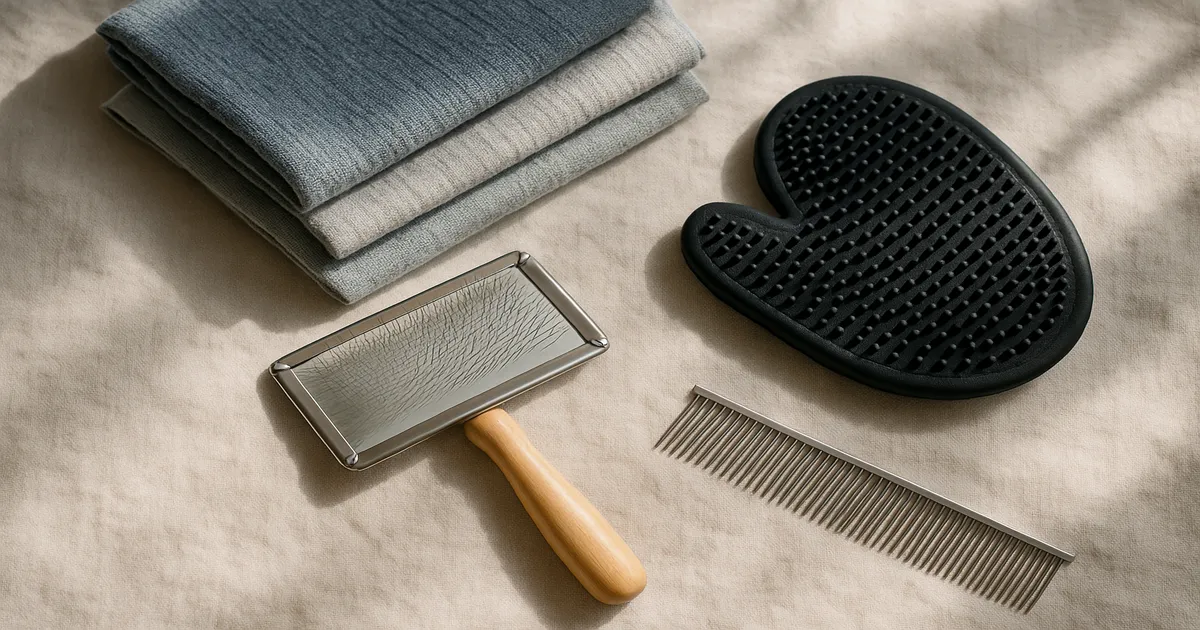
A rubber curry brush once a week is all most smooth-coated dogs need. (Kong ZoomGroom) Bathe every 4–6 weeks. Bathing more than every two weeks strips the natural oils that keep skin supple and the coat glossy — you’ll notice dry, flaky skin and increased scratching within a few cycles.
Double Coats: Never Shave Them
Examples: Siberian Husky, German Shepherd, Golden Retriever, Maine Coon
Brush 2–3 times per week, and daily during spring and fall shedding seasons. Bathe every 6–8 weeks using a deshedding shampoo that loosens the undercoat without stripping the guard hairs.
Never shave a double-coated dog. It’s one of the most common grooming mistakes owners make, usually with good intentions in summer. Shaving destroys the coat’s insulating properties and can actually increase heatstroke risk by removing the barrier that keeps radiant heat off the skin. It also causes post-clipping alopecia in up to 30% of shaved Huskies and Malamutes — a condition where the coat grows back with permanently altered texture, or doesn’t fully grow back at all.
Continuously Growing Coats: Daily Brushing Is Non-Negotiable
Examples: Poodle, Bichon Frisé, Maltese, Shih Tzu, Portuguese Water Dog
These coats need brushing every day or every other day — no exceptions. Bathe every 2–4 weeks and always follow with a quality conditioner. Over-bathing without conditioning makes the hair brittle, which paradoxically causes more matting. Skip grooming long enough and you get pelting — severe mats pressed tight against the skin that can only be removed under veterinary sedation. That’s a medical emergency, not a bad hair day.
Wire and Rough Coats: Stripping vs. Clipping
Examples: Wire Fox Terrier, Scottish Terrier, Brussels Griffon
Wire coats need weekly brushing and bathing every 4–6 weeks. The key distinction is how you remove dead coat. Show dogs require hand-stripping — pulling dead hair out by the root every 6–12 months — to maintain the correct harsh texture. Clipping softens the coat permanently. For a pet owner, clipping is perfectly fine; just know that frequent clipping can degrade the coat’s natural structure over time.
Hairless Breeds: Skin Care Replaces Coat Care
Examples: Xoloitzcuintli, Chinese Crested (hairless variety), Sphynx cat, Peterbald cat
Weekly bathing with a gentle, pH-balanced, fragrance-free pet shampoo keeps oil buildup and skin fold debris under control. Apply a pet-safe moisturizer afterward to prevent cracking, and use pet-formulated sunscreen for outdoor time.
Avoid human skincare products. Dog and cat skin has a pH of 6.2–7.4, while human skin sits at 4.5–5.5. Human products — even gentle ones — are too acidic for pet skin and can cause chemical burns and chronic irritation. Bathing more than once a week also disrupts the skin’s microbiome and opens the door to bacterial and fungal infections.
Nails, Ears, and Brushing: Frequency Limits for Specific Tasks
Nail Trimming
- Dogs: Every 3–4 weeks. If you hear nails clicking on hard floors, they’re already too long.
- Cats: Every 2–3 weeks for indoor cats; outdoor cats may self-maintain on rough surfaces.
Trimming more often than every two weeks risks repeatedly cutting the quick — the blood vessel inside the nail. That’s painful, creates infection risk, and teaches your pet to dread nail trims. In the other direction, severely overgrown nails can curl back into the paw pad, causing embedded nail syndrome that requires veterinary treatment.
Ear Cleaning
- Floppy-eared dogs (Basset Hound, Cocker Spaniel, Labrador): Every 1–2 weeks with a vet-approved ear cleaner (Virbac Epi-Otic Advanced Ear Cleanser)
- Erect-eared dogs (German Shepherd, Siberian Husky): Monthly, or when visibly dirty
- Cats: Monthly, or as needed
A 2021 study in Veterinary Dermatology found that dogs whose ears were cleaned more than twice weekly had a 3× higher rate of ear infections than those cleaned every 1–2 weeks. Over-cleaning removes protective cerumen (earwax) and disrupts the ear’s natural self-cleaning mechanism — the opposite of what you’re trying to achieve.
Brushing Sessions
Keep sessions to 15–20 minutes for dogs and 5–10 minutes for cats. Beyond those windows, most pets hit their tolerance limit, and pushing through teaches them that grooming is something to escape — not something to tolerate.
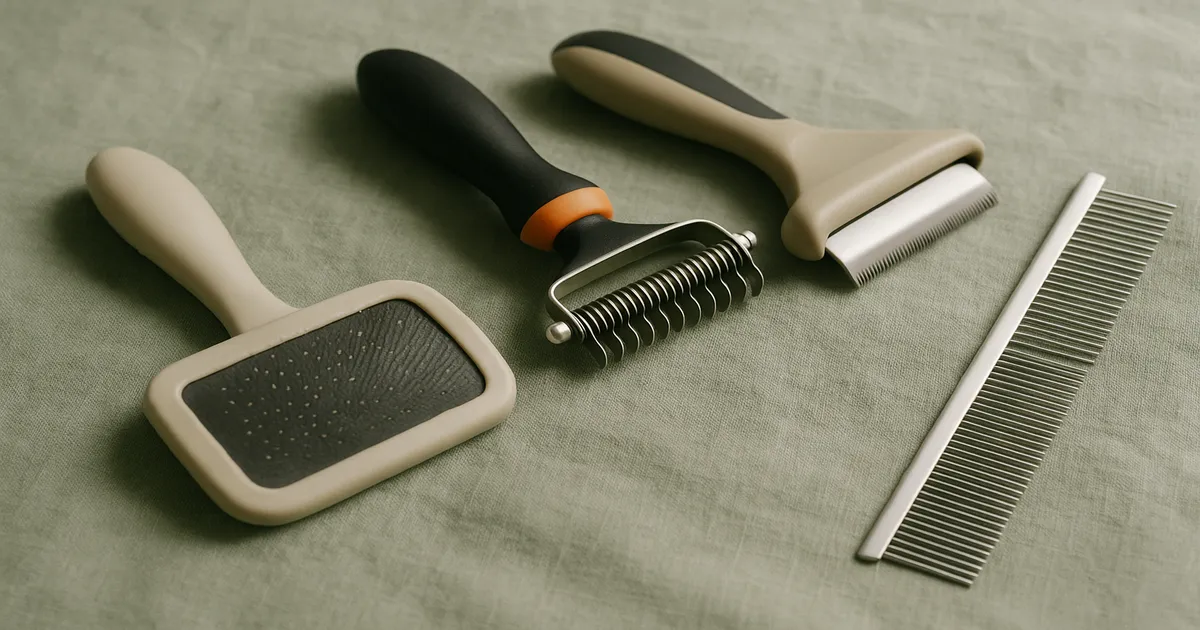
Aggressive use of a metal-pinned slicker brush on thin-skinned or short-coated pets causes abrasion dermatitis: red, raw skin that looks like rug burn. Multiple short, positive sessions with treats are far more effective than one long, stressful ordeal.
Signs You Are Grooming Too Much — or Not Enough
Warning Signs of Over-Grooming
- Dry, flaky, or irritated skin after bathing
- Dull, brittle coat that breaks easily
- Red or raw skin from brushing (abrasion dermatitis)
- Repeated ear infections
- Nails bleeding frequently
- Permanent coat texture change after shaving
- Pet hides or becomes aggressive when grooming tools appear
Warning Signs of Under-Grooming
- Visible mats or tangles in the coat
- Nails clicking on floors or beginning to curl
- Odor from ears, skin folds, or coat
- Excessive scratching or scooting
- Debris or fecal matter trapped in fur
- Skin fold dermatitis (especially in Bulldogs, Shar-Peis, and Pugs)
- Anal gland impaction in predisposed breeds
When to See a Vet
See a vet — not just a groomer — if you notice repeated ear infections, skin infections or hot spots, nails embedded in paw pads, mats that can’t be safely brushed out, significant hair loss after shaving, or any signs of pain during routine handling. Some of these conditions require medical treatment before grooming can safely resume.
How Grooming Affects Pet Behavior and Mental Health
Stress Signals During Grooming
Growling, biting, hissing, and trying to escape are obvious signals. Subtler ones include lip licking, yawning, whale eye (showing the whites of the eyes), and going limp. That last response — learned helplessness — looks like cooperation but is actually a shutdown response and a serious welfare concern. If you see it, stop the session and consult a trainer or veterinary behaviorist.
Compulsive Self-Grooming in Cats
When a cat licks itself bald, the cause is often psychological rather than physical. Feline psychogenic alopecia — triggered by stress, anxiety, or environmental change — affects an estimated 10–15% of cats presenting with hair loss. The belly, inner thighs, and flanks are common sites. A vet visit is essential to rule out allergies and parasites before concluding the cause is behavioral.
Acral Lick Dermatitis in Dogs
Acral lick dermatitis is the canine equivalent — repetitive licking of a specific spot, usually on the lower leg, until a raw, thickened lesion forms. It’s especially common in Dobermans, German Shepherds, and Labrador Retrievers. Anxiety, boredom, and obsessive-compulsive tendencies all play a role, and the condition is notoriously difficult to resolve without addressing the underlying cause.
Forced Grooming and the Human-Animal Bond
Sensitive breeds like Greyhounds and Chihuahuas have thin skin and low pain tolerance — rough brushing or cold water causes real distress. Independent breeds like Chow Chows and most cats resist handling on principle. Forcing these animals through long grooming sessions doesn’t build tolerance; it builds fear and resentment. Short, reward-based sessions — even just 2–3 minutes — done consistently will get you further than any marathon grooming battle.
Frequently Asked Questions About How Much Grooming Is Too Much
How often should you bathe a dog without drying out their skin?
For most dogs, every 4–6 weeks strikes the right balance between cleanliness and skin health. Short-coated breeds can go 6–8 weeks between baths; continuously growing coats may need bathing every 2–3 weeks. Always use a pH-balanced dog shampoo and follow with conditioner on longer coats — human products are too acidic for dog skin and will cause irritation over time.
Is it bad to brush your dog every day?
It depends on the coat type. Daily brushing is genuinely necessary for continuously growing coats like Poodles and Shih Tzus — skipping even a few days can lead to matting. For short or smooth coats, daily brushing isn’t harmful if you use a soft tool and a light hand, but it’s not necessary. For double-coated breeds, daily brushing during shedding season is helpful; the rest of the year, 2–3 times per week is plenty.
Can you groom a cat too much?
Yes. Bathing a healthy shorthaired cat more than once a month is unnecessary and can strip natural skin oils, leading to dryness and irritation. Brushing too aggressively — or too frequently with a harsh tool — can cause skin abrasion. For longhaired cats, daily brushing is appropriate, but keep sessions short and use a gentle touch. If your cat is over-grooming itself, that’s a separate issue that warrants a vet visit.
How do you know if grooming is causing your pet stress?
Watch for stress signals: lip licking, yawning, whale eye, flattened ears, tucked tail, freezing, or trying to escape. More subtle is “learned helplessness” — a pet that goes completely still and limp. This looks like tolerance but is actually a shutdown response. If you see these signs consistently, shorten your sessions, add high-value treats, and consider working with a trainer who uses positive reinforcement methods to build a more comfortable grooming routine.
What happens if you never groom a dog?
The consequences range from uncomfortable to medically serious. Nails will overgrow and eventually curl into the paw pads. Continuously growing coats will pelt — forming dense mats pressed against the skin that trap moisture, restrict circulation, and hide wounds. Ears in floppy-eared breeds will accumulate debris and become infected. Anal glands in predisposed breeds may impact and rupture. “Low-maintenance” breeds fare better, but no dog does well with zero grooming indefinitely.