Quick Answer: During the teething phase (roughly 3–6 months), plan to replace your puppy’s leash every 4–8 weeks — sometimes more often. That pace slows to every 3–6 months through adolescence, and once your dog is fully grown, an annual inspection-and-replace routine is usually sufficient. Always replace immediately if you spot any safety-compromising wear, no matter where you are in the schedule.
How often do you get a new leash for your puppy? If you answered “once a year,” you’re in good company — but you’re also replacing far less often than safety guidelines recommend. Most new puppy owners are genuinely surprised by how quickly a leash can go from brand new to borderline dangerous. Teething, explosive growth, and adolescent pulling all work against leash longevity in ways that adult dog ownership simply doesn’t prepare you for.
How Often Should You Replace a Puppy’s Leash?
Replacement Frequency at a Glance
| Age | Replacement Frequency | Primary Driver |
|---|---|---|
| 8–16 weeks | Every 4–8 weeks | Teething, sizing |
| 4–6 months | Every 4–6 weeks | Peak teething |
| 6–12 months | Every 3–6 months | Pulling, growth |
| 12–18 months | Every 6–12 months | Normal wear |
| 18 months+ | Annually or as needed | Wear and safety |
Surveys suggest the average owner replaces leashes only once a year — fine for a calm adult dog, but genuinely risky during puppyhood.
Why Puppies Go Through Leashes So Fast
Three things drive accelerated leash wear in puppies that simply don’t apply to adult dogs.
Teething. Between 3 and 6 months, puppies chew everything. A leash dangling in front of them is an irresistible target. Pulling. Adolescent dogs (6–18 months) often pull harder than they ever will as adults, stressing stitching and hardware constantly. Rapid growth. A leash sized for a 10-pound puppy at 8 weeks is the wrong tool for a 40-pound adolescent at 5 months. Size mismatches affect both safety and training outcomes.
Getting a New Leash for Your Puppy: Stage-by-Stage Guide
Stage 1: 8–16 Weeks — Starting Out Right
At this stage, comfort and positive association matter more than durability. Start with a lightweight 4-foot nylon or soft rope leash — ⅜ to ½ inch wide for small and medium breeds, ½ to ¾ inch for large breeds. The American Veterinary Society of Animal Behavior (AVSAB) recommends beginning leash training as early as 7–8 weeks, so getting the fit right from the start matters.
Expect to replace every 4–8 weeks, mainly due to teething and rapid growth. Budget for 2–3 leashes during this window and don’t overthink the purchase — affordable nylon is exactly right here. A basic 6-foot flat nylon leash is all you need to get started.
Stage 2: 4–6 Months — Peak Teething Phase
This is the highest-replacement period of your puppy’s life. Teething peaks around 4–5 months, and many owners find themselves replacing leashes monthly or even more frequently. A chain leash used as a secondary option can slow this down — the texture discourages chewing — but it shouldn’t be your only leash, and it’s not suitable for small breeds due to weight.
Plan on 2–3 replacements during this phase alone. Keep a backup on hand so a chewed leash never leaves you without a safe option.
Stage 3: 6–12 Months — Adolescent Pulling
Teething is mostly behind you by 6–7 months, but now you’re dealing with a stronger, more willful dog. Adolescent pulling peaks during this window and puts real stress on stitching, D-rings, and snap hooks. Upgrade to a leash sized for your dog’s projected adult weight rather than current weight — this is the stage where undersized hardware starts to become a genuine safety concern.
Replacement interval here is every 3–6 months, depending on how hard your dog pulls and what material you’re using.
Stage 4: 12+ Months — Transitioning to an Adult Leash
Once your dog reaches projected adult size, it’s time to invest in a quality adult leash. A well-made leather or biothane leash purchased at this stage can last 3–7 years with proper care — a very different economics equation than the frequent nylon replacements of puppyhood. Annual inspection-and-replace is the standard from here, though you should always replace sooner if wear indicators appear.
Warning Signs: When to Get a New Leash Immediately
No schedule overrides a safety problem. Replace immediately if you see any of the following:
- Frayed or split webbing — the leash can snap under tension
- Bent, cracked, or stiff snap hook — clip failure is a leading cause of dog escapes
- Worn or stretched D-ring — the attachment point itself is compromised
- Stitching separation at the handle or clip — these are the highest-stress points on any leash
- Chew damage exceeding 25% of leash width — structural integrity is gone
- Rust on any metal hardware — weakens metal and can cut a handler’s hand
- Stiff, cracked leather — the material has degraded beyond safe use
- Mold or persistent odor — signals bacterial growth and material breakdown
A snapped leash near traffic isn’t a near-miss — it’s a life-threatening event.
Monthly Leash Inspection Checklist
Run through this quickly every four weeks:
- Run fingers along the entire length — feel for thin spots, fraying, or soft patches
- Flex the snap hook spring — should snap crisply with no stiffness or play
- Check all stitching points, especially at the handle and clip attachment
- Inspect the D-ring and any swivel hardware for bending or deformation
- Smell the leash — a persistent odor signals bacterial growth
- Measure at the narrowest point — replace if width has reduced by more than 20%
- Test the clasp under moderate tension before attaching to your puppy
Choosing the Right Leash Material
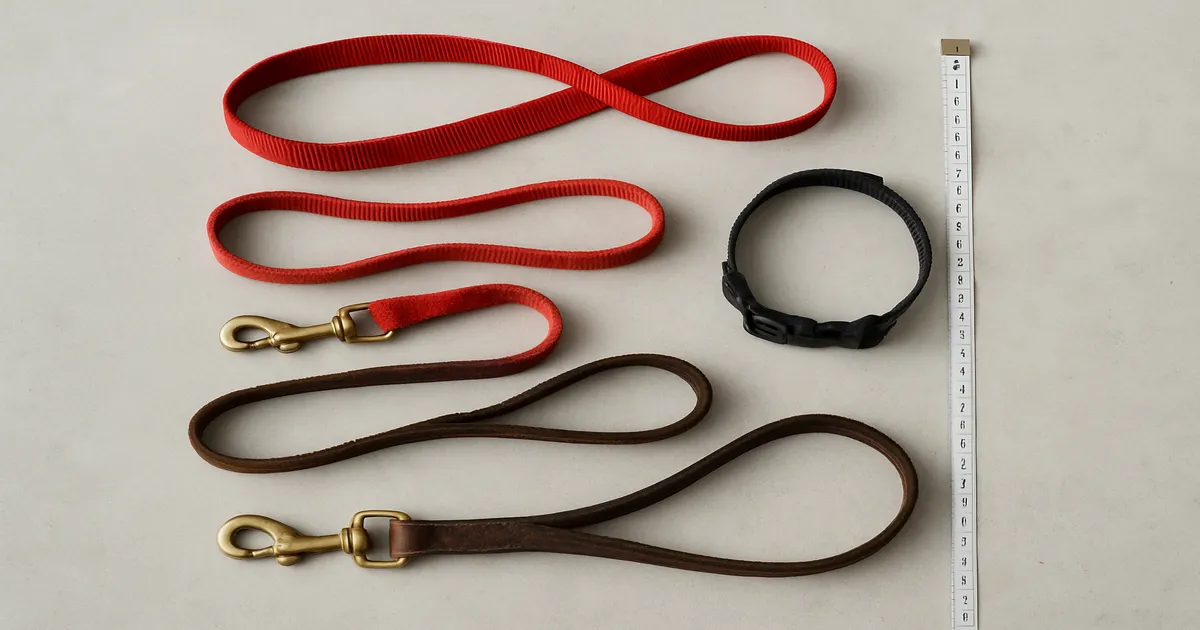
Nylon — Best for Puppies
Nylon is the right call for puppies. It’s affordable enough to replace frequently, easy to clean (machine wash on cold, air dry), and available in every size and width you’ll need. A heavy chewer can shorten its lifespan to 2–4 months, but at $8–$25 per leash, that’s an acceptable trade-off. Buying in multipacks cuts the per-unit cost by 30–50%.
Leather — A Long-Term Investment Worth Waiting For
Leather leashes are genuinely excellent — but not for puppies. A quality leather leash costs $25–$80+, develops a beautiful patina with use, and can last 3–7 years with conditioning every 1–3 months. The problem is that a teething puppy will destroy one in an afternoon. Save leather for the 12-month transition when your dog is past the chewing phase.
Biothane — The Waterproof All-Rounder
Biothane is a coated polyester webbing that looks and feels like leather but is fully waterproof, odor-resistant, and wipes clean with a damp cloth. It costs $20–$50 and lasts 3–5 years under normal use. It’s an excellent upgrade at the 6–12 month stage for active owners, outdoor dogs, or anyone in a wet climate.
Rope and Chain — Situational Options
Braided rope leashes are soft on hands and gentle for puppies, but they fray with chewing and typically last 4–12 months. Chain leashes deter chewing effectively, but use them with caution — heavy chain can injure small puppies and should only be used under supervision. Neither is an everyday solution; both have their place in specific situations.
Matching Leash to Your Puppy’s Size and Temperament
Leash Width by Projected Adult Size
Size for projected adult weight from 6 months onward — not current weight.
| Projected Adult Weight | Leash Width |
|---|---|
| Under 10 lbs (4.5 kg) | ⅜ inch (9.5 mm) |
| 10–25 lbs (4.5–11 kg) | ½ inch (12.7 mm) |
| 25–60 lbs (11–27 kg) | ¾ inch (19 mm) |
| 60–100 lbs (27–45 kg) | 1 inch (25.4 mm) |
| 100+ lbs (45+ kg) | 1–1.5 inches (25–38 mm) |
Leash Length by Activity
- 4 feet — obedience training and crowded areas; maximum control
- 6 feet — neighborhood walks; the industry standard
- 15–30 feet — long lines for recall training; not for regular walks
The APDT and AVSAB both advise against retractable leashes during the puppy training phase. They teach pulling by rewarding forward momentum and give handlers far less control in an emergency.
Budget Planning: Leash Costs for Your Puppy’s First Year
Plan on 6–9 leashes in year one. Most will be inexpensive nylon replacements, with one quality investment at the 12-month mark.
| Phase | Leashes Needed | Avg. Cost Each | Phase Total |
|---|---|---|---|
| 8–16 weeks | 2–3 nylon starters | $10–$15 | $20–$45 |
| 4–6 months | 2–3 replacements | $12–$20 | $24–$60 |
| 6–12 months | 1–2 upgrades | $15–$30 | $15–$60 |
| 12+ months | 1 quality adult leash | $25–$80 | $25–$80 |
| Year 1 Total | 6–9 leashes | — | $84–$245 |
This is normal and expected. Don’t let sticker shock push you toward keeping an unsafe leash in service.
Leash Care Tips to Extend Lifespan
Hang leashes rather than coiling them tightly — tight coils create stress points in webbing over time. Keep them away from direct sunlight, which degrades nylon up to 40% faster. Always dry leashes thoroughly before storing, since trapped moisture promotes mold and weakens fibers. Rotating two leashes in active use is a simple habit that meaningfully extends the lifespan of each one.
Cleaning by material:
- Nylon: Machine wash on cold or hand wash with mild soap; air dry completely
- Leather: Wipe clean with a damp cloth; condition every 1–3 months
- Biothane: Wipe down with a damp cloth; no conditioning needed
- Rope: Hand wash; check braid integrity monthly
- Chain: Wipe dry after wet conditions; check links for rust monthly
Climate matters more than most owners realize. In wet environments, nylon and biothane outperform leather. Near the ocean, rinse all hardware after every beach trip — saltwater accelerates metal corrosion dramatically.
Frequently Asked Questions
How often do you get a new leash for your puppy during teething?
At peak teething — around 4–5 months — plan on replacing every 4–6 weeks. Some owners with heavy chewers do it even more frequently. Keep a backup leash on hand so you’re never caught without a safe option after a chewing incident.
What is the best leash material for a puppy that chews?
For deterrence, a chain leash used under supervision is the most effective option — most puppies quickly lose interest in chewing metal. For durability without chain, heavy-duty nylon or biothane holds up better than standard nylon. Either way, budget for more frequent replacements during the teething phase; no material is truly chew-proof.
When should I switch from a puppy leash to an adult leash?
Around 12 months, or when your puppy reaches their projected adult size — whichever comes first. At that point, invest in a quality leather or biothane leash sized for your dog’s adult weight. This is the leash that can realistically last 3–7 years with proper care, so it’s worth spending more than you did on puppy leashes.
Are retractable leashes safe for puppies?
No — the APDT and AVSAB both advise against them during the training phase. Retractable leashes reduce handler control in emergencies and reward pulling by giving the dog more leash when they lunge forward. That’s the opposite of what you want to reinforce. Stick to a standard 4- or 6-foot leash until your dog has solid leash manners.
How do I know if my puppy’s leash is unsafe to use?
Check for frayed or split webbing, a stiff or bent snap hook, stitching separation at the handle or clip, chew damage exceeding 25% of the leash width, rust on any hardware, or cracked leather. If any of these are present, replace the leash before your next walk — not after.