Quick Answer: Puppies freak out in crates because they haven’t learned that being alone is safe — not because they’re being stubborn. The fix is gradual desensitization, smart crate setup, and a consistent pre-crate routine. Most puppies calm down significantly within one to three weeks when you follow a structured approach.
If you’re searching “how to stop puppy from freaking out in crate when alone,” you’re probably exhausted and second-guessing yourself. You’re not doing anything wrong. Crate panic is one of the most common challenges new puppy owners face — and it’s almost always fixable with the right approach.
Why Your Puppy Freaks Out in the Crate When Alone
Your puppy isn’t being dramatic. From their perspective, they’ve gone from a warm litter of siblings to a small box in a strange house where their person keeps disappearing. That’s genuinely alarming. The crying, scratching, and spinning are their way of saying “I don’t feel safe yet.”
There are five core reasons puppies panic in crates:
- Separation distress — they haven’t learned you’ll come back
- Confinement anxiety — the enclosed space itself feels threatening
- Negative association — the crate was introduced too fast or used as punishment
- Under-stimulation — they’re bursting with energy and have nowhere to put it
- Clinical separation anxiety — a genuine medical condition affecting an estimated 17–29% of dogs (Tiira & Lohi, 2015)
Separation Distress vs. True Separation Anxiety
These two things sound the same but require very different responses. Separation distress is normal puppy behavior — they protest when you leave, then eventually settle. True separation anxiety is a clinical condition involving a dysregulated stress-response system, elevated cortisol, and symptoms that don’t improve with standard training alone.
| Behavior | Normal Protest | Clinical SA |
|---|---|---|
| Duration of crying | Stops within 15–30 min | Continuous until return |
| Intensity | Decreases over time | Escalates or stays constant |
| Physical symptoms | Rare | Hypersalivation, self-harm |
| Response to training | Improves steadily | Minimal improvement alone |
| Trigger | Confinement | Owner departure specifically |
If your puppy’s distress escalates rather than fades over weeks of consistent training, skip ahead to the clinical separation anxiety section below.
Breed Tendencies and Developmental Windows
Some dogs are simply harder to crate than others — and that’s genetics, not a training failure. Breeds developed for constant human contact tend to struggle most: Cavalier King Charles Spaniels, Maltese, Bichon Frises, Border Collies, Australian Shepherds, Beagles, and livestock guardian breeds like the Great Pyrenees. Breeds that typically adapt more readily include Golden Retrievers, Labrador Retrievers, Basset Hounds, and Greyhounds.
Timing matters too. The 8–12 week window is ideal for introducing a crate positively, since puppies are in their peak socialization period and forming lasting associations quickly. Be especially gentle during the 8–11 week fear imprint period — a single frightening crate experience during this window can create a lasting aversion.
Rule Out Medical Problems Before You Train
Before starting any training protocol, rule out physical causes. A puppy who can’t stop crying in a crate might be in pain or discomfort, not being difficult. Common culprits include UTIs (especially in female puppies), intestinal parasites (affecting up to 34% of U.S. puppies according to the CDC), panosteitis in large breeds, hip dysplasia, and GI discomfort from food sensitivities.
Certain breeds carry additional risk: Bulldogs and Pugs with airway obstruction (BOAS) can struggle in a warm, enclosed space; Cavalier King Charles Spaniels may have Syringomyelia causing pain-related distress; Dachshunds are prone to spinal disc disease that makes lying on a hard crate floor genuinely painful.
If the distress is sudden, severe, or accompanied by hypersalivation, vomiting, limping, or bloody stool, see your vet before doing anything else. Training a puppy who is physically uncomfortable will not work — and it isn’t fair to them.
How to Stop Your Puppy From Freaking Out in the Crate: 5-Step Plan
Step 1: Build a Positive Crate Association From Scratch
The crate needs to become the best spot in the house. Start by tossing high-value treats just inside the open crate and letting your puppy wander in and out freely. Feed meals inside with the door open. Never push your puppy in, never lock them in as a consequence, and never use the crate when you’re frustrated. The goal at this stage is simple: the crate predicts good things.
Step 2: Desensitize Gradually — Seconds Before Minutes Before Hours
Once your puppy enters the crate willingly, start closing the door — for three seconds. Then five. Then thirty. Then a few minutes. The progression should feel almost boringly slow; that’s exactly right. If your puppy panics, you’ve moved too fast. Back up a step and rebuild from there.
Systematic desensitization is the only reliable way to change how a puppy feels about the crate, not just what they do in the moment.
Step 3: Use a Consistent Pre-Crate Wind-Down Routine
Puppies pick up on pre-departure cues fast — grabbing your keys, putting on shoes, reaching for your bag. These signals start triggering anxiety before you’ve even left. A calm, predictable pre-crate sequence breaks that pattern:
- 30–45 minutes before: Active exercise — a walk, fetch, or play session
- 10–15 minutes before: Calm mental enrichment — a frozen Kong or snuffle mat
- 5 minutes before: Quiet interaction, no exciting games
- Crate, with an enrichment item inside
Keep departures and arrivals low-key. No dramatic goodbyes, no excited greetings that make your return feel like a major event.
A frozen Kong stuffed with kibble and peanut butter buys 20–45 minutes of calm, focused activity. Lick mats work on the same principle — repetitive licking triggers serotonin release, which genuinely calms the nervous system. (LickiMat Wobble) For puppies who need more of a challenge, snuffle mats tap into natural foraging instincts and extend settling time.
Step 4: Respect Age-Based Time Limits
| Age | Maximum Crate Time |
|---|---|
| 8–10 weeks | 1–2 hours |
| 10–12 weeks | 2 hours |
| 3–4 months | 2–3 hours |
| 4–5 months | 3–4 hours |
| 6+ months | Up to 4–5 hours |
These aren’t suggestions. Exceeding them sets your puppy up to fail. A puppy who physically can’t hold their bladder will eliminate in the crate, panic, and form a strong negative association with it.
Step 5: Respond Correctly When Your Puppy Cries
This is where most owners get stuck. Responding every time your puppy whimpers can reinforce the behavior — but ignoring genuine distress is both cruel and counterproductive. The key is learning to distinguish between the two.
Protest crying — whining, barking, a pause, then starting again — typically resolves if you don’t react. Wait for even a two-second pause, then calmly open the crate. Distress crying — escalating, frantic, non-stop — usually means you’ve moved too fast or your puppy genuinely needs to eliminate. Also expect extinction bursts: things often get louder before they get quieter. That’s normal. Stay consistent.
Crate Setup: The Sensory Environment That Calms Puppies
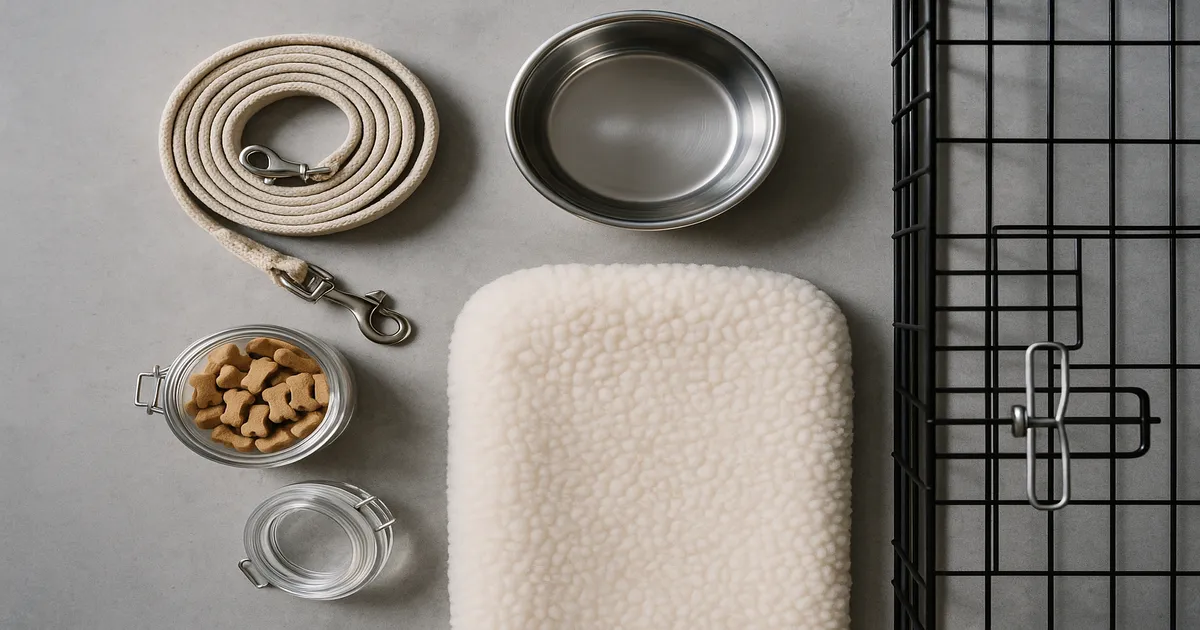
Size: The crate should be just big enough for your puppy to stand up, turn around, and lie down — nothing more. A crate that’s too large gives them room to eliminate in one corner and sleep in another, which undermines housetraining. Buy the adult-size crate and use a divider panel to shrink the space as your puppy grows.
Type: Wire crates offer great ventilation but feel exposed — cover three sides with a blanket to create a den effect. Plastic airline-style crates are naturally more enclosed and tend to suit anxious dogs better. Avoid soft-sided crates for puppies; they chew through them and can escape.
Location: For the first two to four weeks, keep the crate in your bedroom. Your scent and the sound of your breathing provide real reassurance, and nighttime crying drops dramatically. Gradually move the crate toward its permanent location once your puppy is settled. Avoid isolated rooms like laundry rooms or garages — social isolation amplifies anxiety.
Comfort tools: Research by Bremhorst et al. (2018) found that placing an unwashed item of your clothing in the crate measurably reduces stress vocalizations. A heartbeat puppy toy mimics the warmth and rhythm of a littermate and has clinical support for reducing crying in newly separated puppies. A white noise machine masks startling sounds that trigger barking. (LectroFan Classic) Adaptil (DAP) diffusers release a synthetic version of the calming pheromone nursing mothers produce; studies show a 60–70% reduction in anxiety-related behaviors with consistent use.
Keep the crate between 65–75°F (18–24°C) — puppies can’t regulate body temperature effectively. And trim nails every two to three weeks: overgrown nails catch on wire grates, cause pain, and create a strong negative association with the crate.
When Normal Training Isn’t Enough
Signs of Clinical Separation Anxiety
Most puppies improve with consistent training. If yours isn’t, watch for these red flags:
- Non-stop vocalization from the moment you leave until you return
- Self-injury — bloody paws, broken nails, damaged gums from crate chewing
- Hypersalivation and excessive drooling
- Elimination despite being reliably housetrained
- Symptoms that escalate rather than decrease over weeks of training
Getting Professional Help
If you’re hitting a wall, don’t keep grinding through the same protocol. Seek out an IAABC-certified separation anxiety trainer (CSAT) or a veterinary behaviorist (DACVB). Veterinary behaviorists are board-certified specialists — the equivalent of a psychiatrist for dogs — and they can assess whether medication is appropriate alongside behavioral modification.
Two medications are FDA-approved specifically for canine separation anxiety: Fluoxetine (Reconcile) and Clomipramine (Clomicalm). Situational adjuncts like Trazodone are sometimes used alongside these. Critically, medication alone doesn’t teach coping skills. It must always be paired with behavioral modification — the medication lowers the anxiety floor enough for training to take hold.
Alternatives to the Crate
Some dogs genuinely cannot tolerate crating, even with expert help. That’s okay — a crate is a tool, not a requirement. Exercise pens offer more space with less claustrophobia and work well for puppies who struggle with confinement specifically. Baby gates to section off a puppy-safe room are another solid option.
Frequently Asked Questions
How long does it take to stop a puppy from freaking out in the crate? Most puppies show real improvement within one to three weeks of consistent training. Puppies with true separation anxiety or a history of negative crate experiences may take longer — sometimes two to three months with professional guidance.
Should I let my puppy cry it out in the crate? Not entirely. Ignoring brief protest crying (whining that pauses and restarts) is reasonable. Ignoring escalating, frantic distress is not — it doesn’t teach coping skills and can worsen anxiety. The goal is to set up training so your puppy rarely reaches that level of distress in the first place.
Is it cruel to crate a puppy at night? No, provided the crate is introduced positively, sized correctly, and placed near you. Most puppies sleep more soundly in a crate than loose in a room, because the enclosed space feels den-like and secure. Keeping the crate in your bedroom for the first few weeks makes a significant difference.
My puppy is fine in the crate when I’m home but panics when I leave. What’s going on? This is a classic sign of separation-triggered anxiety rather than confinement anxiety. The crate itself isn’t the problem — your departure is. Focus on desensitizing your puppy to departure cues (keys, shoes, bag) and practice very short absences, building duration slowly.
At what age can I stop crating my puppy? Most dogs can be trusted with more freedom between 12 and 18 months, once they’re reliably housetrained and past the destructive chewing phase. Introduce freedom gradually — start with one room, then expand — rather than giving full house access all at once.