Quick Answer: The most effective dog training tips for beginners come down to five things: use positive reinforcement, keep sessions short, exercise your dog before training, stay consistent with cues, and understand what your dog was bred to do. Most dogs can learn basic commands within a few weeks — but building reliable, distraction-proof behavior takes two to six months of regular practice.
Getting started with dog training feels overwhelming at first, but the fundamentals are simpler than most beginners expect. Whether you’ve just brought home a Labrador puppy or adopted an adult rescue, the core dog training tips for beginners stay the same: reward what you want, ignore or redirect what you don’t, and practice every single day.
Dog Training Tips for Beginners: The 5 Golden Rules
- Use positive reinforcement — reward the behavior you want within 2 seconds of it happening
- Keep sessions short — 3–5 minutes for puppies, 10–15 minutes for adult dogs
- Exercise first — a physically settled dog is a focused dog
- Be consistent — every person in the household must use the same cues
- Know your dog’s breed — a Beagle and a Border Collie need completely different training approaches
How Long Does It Take to Train a Dog?
| Goal | Puppy (Under 6 Months) | Adult Dog |
|---|---|---|
| Learns a new command | 1–2 weeks | 1–3 weeks |
| Reliable in low-distraction environments | 3–4 weeks | 2–4 weeks |
| Reliable around distractions | 3–6 months | 2–6 months |
| Fully house-trained | 4–6 months | 2–8 weeks |
Adult dogs often learn faster than puppies because they have longer attention spans. Don’t let the “missed puppy window” myth discourage you from starting.
Why Breed History Matters Before You Start
Centuries of selective breeding didn’t just change how dogs look — it hardwired specific behavioral tendencies into their brains. A Beagle’s nose-driven focus, a Border Collie’s herding instinct, a Jack Russell’s explosive prey drive — these aren’t personality quirks. They’re deeply ingrained patterns that directly affect how your dog learns.
Working with those instincts instead of fighting them is one of the biggest advantages a beginner trainer can have.
AKC Breed Groups and Training Difficulty
| AKC Group | Beginner Difficulty | Representative Breeds |
|---|---|---|
| Sporting | ⭐⭐ Easiest | Labrador, Golden Retriever, Vizsla |
| Herding | ⭐⭐⭐ Moderate | Border Collie, German Shepherd |
| Toy | ⭐⭐⭐ Moderate | Chihuahua, Pomeranian, Maltese |
| Non-Sporting | ⭐⭐⭐ Variable | Bulldog, Dalmatian, Chow Chow |
| Working | ⭐⭐⭐⭐ Challenging | Rottweiler, Akita, Malamute |
| Hound | ⭐⭐⭐⭐ Challenging | Beagle, Afghan Hound, Bloodhound |
| Terrier | ⭐⭐⭐⭐ Challenging | Jack Russell, Airedale, Scottish Terrier |
Sporting breeds — especially Labrador Retrievers and Golden Retrievers — consistently top the list for beginner-friendly training. They were bred to work cooperatively alongside humans, which makes them naturally attuned to your cues and highly food-motivated.
Mixed-breed dogs can also be excellent learners. A 2019 study in PLOS Genetics found that mixed-breed dogs had lower rates of certain behavioral disorders than purebreds — a phenomenon sometimes called hybrid vigor. The catch is unpredictability: you may not know which instincts are dominant until you start working together.
Understanding Temperament, Intelligence, and Energy
Genetics vs. Environment
Research published in Applied Animal Behaviour Science found that a dog’s temperament is roughly 50% genetic and 50% shaped by environment and experience. That’s good news for beginners — your daily training, socialization, and handling have a real, measurable impact on who your dog becomes.
What Canine Intelligence Rankings Actually Mean
Dr. Stanley Coren’s research ranked breeds by working intelligence. Top-tier breeds — Border Collies, Poodles, German Shepherds — can learn a new command in five or fewer repetitions and comply around 95% of the time. At the other end, Afghan Hounds and Bulldogs may need 80–100+ repetitions for the same command.
Here’s the critical point: a lower intelligence ranking doesn’t mean untrainable. It means you’ll need higher-value rewards, more patience, and shorter sessions. An Afghan Hound isn’t ignoring you out of stubbornness — it’s an independent thinker bred to hunt without human direction for miles at a stretch.
Energy Levels and Training Readiness
| Energy Level | Example Breeds | Training Implication |
|---|---|---|
| Very High | Border Collie, Jack Russell, Vizsla | Must exercise before every session |
| High | Labrador, German Shepherd, Boxer | 30-minute walk improves focus significantly |
| Moderate | Bulldog, Shih Tzu, Basset Hound | Minimal warm-up needed; watch motivation |
| Low | Retired Greyhound, Chow Chow | Short sessions; watch for disengagement |
People-oriented breeds like Golden Retrievers and Cavalier King Charles Spaniels respond well to verbal praise and eye contact — a warm “yes!” can be as powerful as a treat. Independent breeds like Chow Chows and Akitas operate on a clearer value exchange: food rewards will outperform praise every time.
Exercise First: The Step Most Beginners Skip
The American Veterinary Society of Animal Behavior is direct on this point: a physically under-exercised dog cannot be trained effectively. Jumping, nipping, and inability to hold a sit are often read as stubbornness. Usually, they’re just excess energy with nowhere to go.
Daily Exercise Requirements by Breed Type
| Breed Category | Daily Minimum | Notes |
|---|---|---|
| High-energy herding/working | 90–120 minutes | Split into 2–3 sessions |
| Sporting breeds (adult) | 60–90 minutes | 2 sessions |
| Average adult mixed breed | 45–60 minutes | 1–2 sessions |
| Toy/companion breeds | 20–30 minutes | 2 short sessions |
| Brachycephalic breeds | 20–30 minutes | Multiple short sessions; avoid heat |
| Puppies (8–16 weeks) | 5 min × age in months, twice daily | See puppy rule below |
The puppy exercise rule: Veterinary orthopedic guidelines recommend no more than 5 minutes of exercise per month of age, twice daily, for puppies under 12 months. A 3-month-old puppy gets 15-minute sessions, twice a day — no more. Growth plates in large breeds don’t close until 12–18 months, and over-exercise before that point raises the risk of hip dysplasia and joint damage.
Activities That Double as Training Opportunities
- Structured leash walks — practice heel, sit at curbs, and “leave it” around distractions
- Fetch — build in a sit/stay before each throw and a “drop it” on return
- Agility — exceptional for high-energy breeds; builds focus and handler communication simultaneously
- Puzzle feeders — University of Bristol research found that 15 minutes of focused mental work can tire a Border Collie more than a 30-minute run; hide kibble or use a puzzle toy to tap into that effect (Outward Hound Nina Ottosson Dog Brick)
Core Dog Training Techniques for Beginners
Positive Reinforcement: The Method That Works
Positive reinforcement means rewarding the behavior you want immediately after it happens — within 2 seconds — so your dog builds a clear association between the action and the reward. It’s not just the kindest approach; it’s consistently the most effective one across decades of animal behavior research.
Match your reward to your dog’s motivation:
- Food-driven dogs (Labradors, Beagles): Small, soft, high-value treats work best — think tiny pieces of chicken or cheese
- Praise-driven dogs (Golden Retrievers, Cavaliers): Enthusiastic verbal rewards and petting can rival food in effectiveness
- Play-driven dogs (terriers, Belgian Malinois): A 10-second tug session often outperforms any treat
Clicker Training: A Step-by-Step Introduction
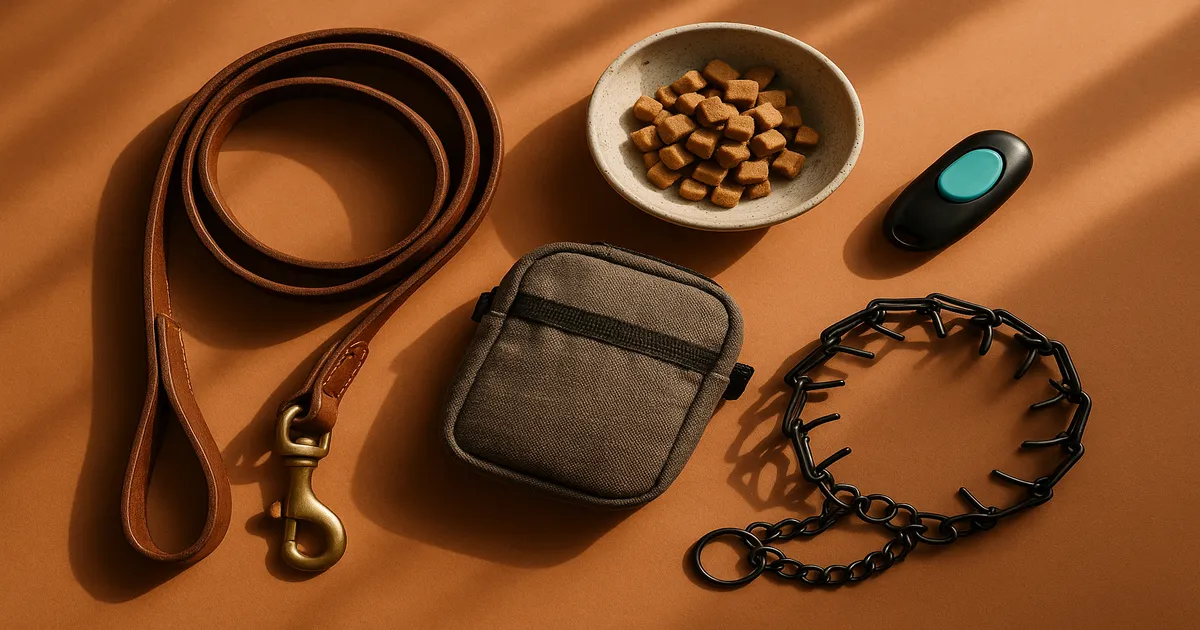
A clicker is a small handheld device that makes a precise, consistent sound — far more accurate than a verbal “good boy” that varies in tone and timing. Here’s how to start:
- Charge the clicker — click and immediately treat 10–20 times so your dog learns the click means reward
- Mark the moment — the instant your dog does the right thing, click then treat
- Keep it short — 3–5 minute sessions, always ending on a success
- Fade the clicker gradually — once a behavior is solid, phase it out and rely on a verbal marker
The 5 Commands Every Dog Should Learn First
- Sit — the foundation of impulse control
- Down — builds on sit; essential for calm behavior
- Stay — teaches your dog to hold position despite distractions
- Come (recall) — the most important safety command you’ll ever teach
- Leave it — prevents dangerous scavenging and redirects attention
Common Beginner Training Mistakes
- Inconsistent cues — saying “come,” “come here,” and “get over here” for the same command confuses your dog
- Sessions that run too long — once focus drifts, you’re practicing failure, not training
- Training while frustrated — dogs read your emotional state; frustration makes them anxious and less receptive
- Skipping proofing — a dog that sits perfectly in the kitchen may not sit at the park; practice every command in new environments with increasing distractions
Building a Training Schedule That Actually Sticks
- Puppies under 6 months: 3–5 minute sessions, 3–5 times daily
- Adult dogs: 10–15 minute sessions, twice daily
Frequency beats duration. Five short sessions a day will produce faster results than one long session that ends with a frustrated dog and a frustrated owner.
Weave training into your existing routine rather than treating it as a separate event. Ask for a sit before meals, a down-stay before opening doors, and a leave it during walks. This kind of real-life training builds habits faster than formal drills alone.
The Socialization Window You Cannot Miss
The socialization window closes at roughly 16 weeks of age. Before that point, puppies are neurologically primed to accept new people, animals, surfaces, sounds, and environments as normal. Miss this window — especially with protective breeds like Rottweilers and German Shepherds — and you significantly increase the risk of fear-based reactivity later in life.
The socialization window and the vaccination schedule overlap awkwardly, which creates real anxiety for new owners. The AVSAB’s position is that the behavioral risk of missing the socialization window outweighs the disease risk of controlled, low-exposure socialization. Puppy classes that require proof of vaccination, visits to healthy dogs’ homes, and carrying your puppy in public spaces are all reasonable options before the vaccine series is complete. Talk to your vet about what’s appropriate in your area.
When to Consider Professional Classes
If you own a high-drive working breed, a protective breed, or a pack-oriented dog like a Husky or Beagle, professional group classes are worth the investment — not just for the instruction, but for the structured social environment. For any beginner feeling out of their depth, a six-week group obedience class provides accountability, expert feedback, and a community of people going through exactly the same thing.
Health Considerations Every Beginner Trainer Should Know
Sudden behavioral changes — increased reactivity, reluctance to sit or lie down, reduced interest in food rewards — are often health signals, not training failures. Before concluding your dog is being stubborn, ask whether something might hurt.
A few breed-specific issues are worth knowing:
- Hip dysplasia (common in German Shepherds, Labradors, and Golden Retrievers) makes sit and down commands genuinely painful. If your dog hesitates or seems reluctant to hold a position, a vet check is warranted before pushing harder.
- Ear infections make noise-sensitive dogs more reactive; if your dog suddenly flinches at the clicker, check those ears.
- Brachycephalic breeds (Bulldogs, Pugs, French Bulldogs) have real exercise and heat limitations — keep sessions short, cool, and never immediately after eating.
The American Veterinary Dental College reports that 80% of dogs show signs of periodontal disease by age 3. Oral pain directly undermines training: a dog with a sore mouth is less food-motivated and more reactive. Daily brushing with a dog-safe toothpaste is the gold standard ; VOHC-approved dental chews are a solid backup.
If your previously food-motivated dog suddenly loses interest in treats, if a well-housetrained dog starts having accidents, or if a friendly dog becomes snappy without apparent cause — call your vet before scheduling a training session. Rule out physical causes first.
Frequently Asked Questions About Dog Training for Beginners
What is the first command you should teach a beginner dog?
Start with sit. It’s the simplest command to teach, it establishes the foundation of impulse control, and it creates an immediate communication win for both of you. Once your dog understands that offering a behavior earns a reward, every subsequent command becomes easier.
How long does it take to train a dog basic commands?
Most dogs can learn the mechanics of a basic command like sit or down within one to two weeks of consistent daily practice. A truly reliable command — one your dog performs correctly in a distracting park, not just your kitchen — typically takes two to six months of proofing in varied environments.
Is it too late to train an adult dog?
Not at all. Adult dogs often learn faster than puppies because they have longer attention spans and can better regulate their impulses. The socialization window may have closed, but the learning window never does. Rescue dogs trained as adults routinely master complex commands and even competitive obedience skills.
How do I stop my dog from getting distracted during training?
Two things help most: exercise your dog before the session, and start practicing new commands in a low-distraction environment before gradually adding distractions. If your dog can’t focus in the backyard, the dog park isn’t the place to practice recall. Build the behavior in easy conditions first, then proof it in harder ones.
Do I need special equipment to start training?
No. A bag of small, soft treats and a quiet space are enough to get started. A clicker adds precision to your timing and is worth the small investment once you’re comfortable with the basics. Beyond that, a well-fitted flat collar or front-clip harness for leash work covers most beginner needs .